



- 15+ Years of Industry Experience
- Complete Range of Grid-Connection & Compensation Products
- Serving Customers in 30+ Countries
- 100+ Intellectual Property Rights
- 12% Annual Revenue Reinvested in R&D Innovation
- Full-Cycle Technical Support and Custom Engineering
Anti-Islanding Protection Relay
Anti-Islanding Protection Relay
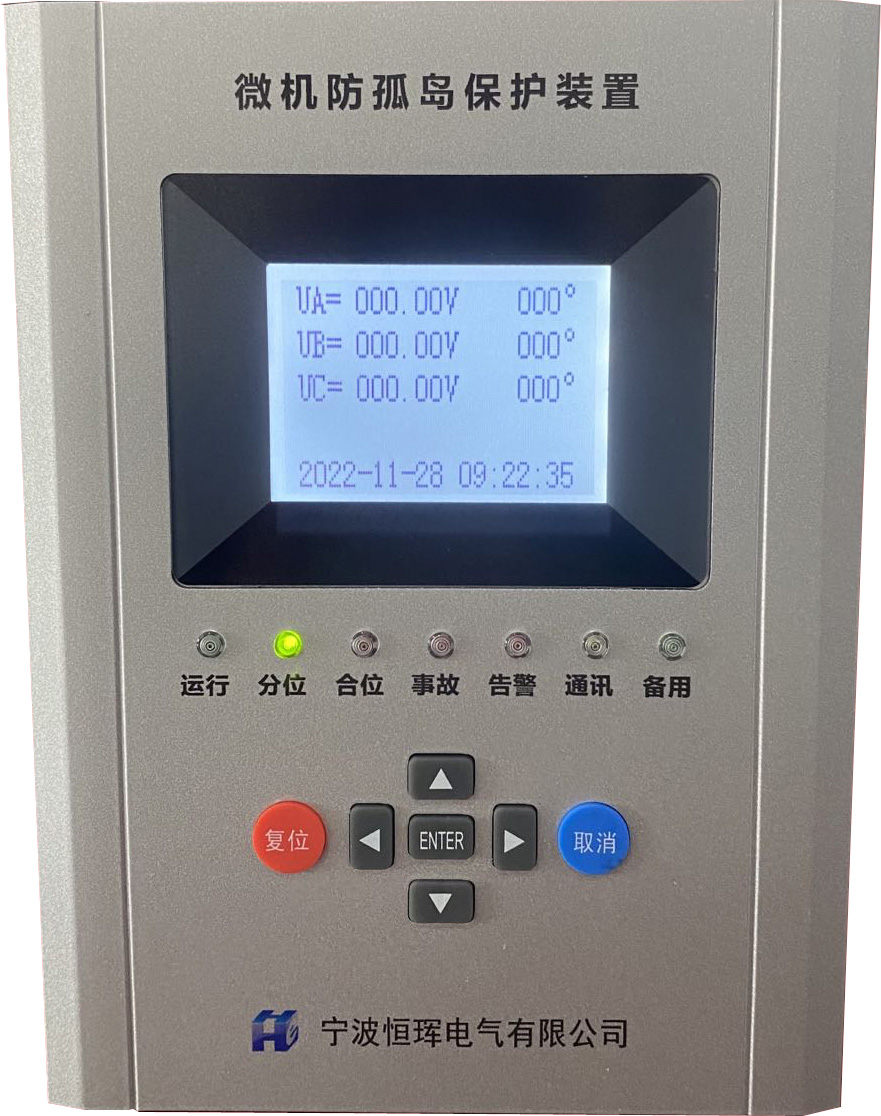
Anti-islanding protection relay for distribution transformer and renewable energy grid connection applications. Provides configurable protection, event records, switch-status monitoring and RS485 communication for integration into the project protection scheme.
Get a Quick Quote
Product Overview
The Henghui anti-islanding protection relay monitors electrical conditions at grid connection points. It provides control signals to help isolate distributed generation when it detects abnormal grid conditions. Panel builders can integrate the device into a control panel or switchgear cabinet as part of the project protection scheme.
Anti-islanding protection relay applications
Typical applications include the low-voltage side of distribution transformers and renewable energy grid connections. First, define the connection diagram and required protection functions. Then match the relay inputs, auxiliary supply and output contacts to the approved design.
The relay provides protection signals to the switching circuit. The complete protection scheme also requires suitable switching equipment, wiring and coordinated settings. Confirm those details for the selected configuration before installation.
Functions and Features
Protection and switching functions
- Two-stage overvoltage, undervoltage, overfrequency, underfrequency and reverse power protection.
- Sudden frequency change protection, overcurrent and overload protection.
- Instantaneous and time-delayed trip functions, plus voltage-recovery closing as configured.
- Anti-pumping circuit and switch-status monitoring.
Inputs, records and communication
- 10 passive switch-status inputs and 3 dry-contact relay outputs.
- 4 AC current inputs and 4 AC voltage inputs.
- 6-channel non-electrical protection inputs.
- CT/PT circuit-disconnection alarms, event records and fault waveform recording.
- Standard RS485 communication for connection to the specified monitoring system.
Confirm the communication protocol, contact ratings and available functions for the ordered version. Panel mounting and individual switchgear installation depend on the project layout.
Technical Specifications
| Auxiliary power supply | AC 85–450 V or DC 100–370 V |
|---|---|
| Rated AC current input | 5 A or 1 A |
| Rated AC voltage | 380 V |
| Rated frequency | 50 Hz |
| Operating temperature | −10°C to +55°C |
| Storage temperature | −40°C to +85°C |
| Relative humidity | ≤95%, non-condensing |
| Atmospheric pressure | 80–110 kPa |
| Current-circuit burden | ≤0.5 VA per phase at 5 A |
| Voltage-circuit burden | ≤0.8 VA per phase at 380 V |
| Device power consumption | ≤5 W as listed in the catalogue |
| Communication | RS485 |
Selection and Application Notes
Define the relay wiring and settings
Provide the grid connection diagram, transformer data and CT ratios. Also specify the voltage-input arrangement, auxiliary supply and required trip or closing logic. These details help confirm the relay configuration and the interface to the switching equipment.
Coordinate anti-islanding and reclosing settings with the project grid connection requirements. Confirm the operating thresholds and time delays during the design review. Qualified personnel should complete wiring checks and functional tests before commissioning.
Confirm the selected version
The table above retains the specifications listed for this product. Final wiring, dimensions, communication protocol and available functions follow the confirmed device version. Request the relevant data sheet and connection drawing with your quotation.
Quotation & Related Products
Request an anti-islanding protection relay quotation
Email Kathy at kathy@nbhh-group.com with the quantity, application and required functions. Attach the single-line diagram and state any documentation or test requirements. We can then review the configuration and quotation scope.
For related equipment, see our photovoltaic grid connection cabinet and reverse power flow protection device. Select each device according to its role in the approved protection scheme.
 English (UK)
 Bahasa Indonesia
 Tiếng Việt
 Deutsch
 Español
 Français
 Português
 Русский