
How Can High Voltage Switchgear Improve Safety and Reliability in 35kV Power Distribution?
In 35kV power distribution, large equipment footprints, limited maintenance space, and demanding insulation and safety requirements can make switchgear selection difficult. Poorly matched equipment may increase installation costs, complicate maintenance, and raise the risk of insulation failure, accidental operation, and unplanned outages. Choosing a properly designed solution such as KYN61-40.5 high voltage switchgear can provide reliable protection, safer operation, and better adaptability to demanding distribution environments. Read on to understand the functions, types, components, and selection factors that matter before purchasing.
What is a high voltage switchgear?
High-voltage (HV) switchgear is electrical equipment used at high-voltage levels, commonly in 35kV-class and above power systems, to control, protect, isolate, and distribute electrical power. It integrates switching devices, protection equipment, busbars, measurement components, and control systems to safely manage electrical circuits. In transmission networks, substations, and large industrial distribution systems, high voltage switchgear helps interrupt faults, isolate equipment for maintenance, and maintain reliable power distribution. Depending on the application and regional standards, HV switchgear may cover different voltage classifications and technologies, including AIS, GIS, and hybrid designs.
Choosing the right configuration is easier once you understand what the equipment actually needs to accomplish.
Why Is High Voltage Switchgear Critical in 35kV Power Distribution?
For a 35kV power distribution system, switchgear is much more than a metal enclosure containing circuit breakers. It is a central part of the electrical protection and control architecture. Its primary responsibility is to control power flow, disconnect faulty circuits, and protect transformers, cables, motors, and other expensive assets from electrical faults.
A well-designed high voltage switchgear system can respond quickly to conditions such as short circuits, overloads, earth faults, and abnormal current conditions. When a fault occurs, the circuit breaker can interrupt the current while protection devices identify the affected section of the network. This prevents a local problem from developing into a wider system outage.
Safety is another major consideration. In a properly engineered switchgear lineup, dangerous energized parts are enclosed and segregated from areas accessible to operators. Mechanical and electrical interlocking can help prevent incorrect switching sequences, while grounding provisions support safer maintenance procedures.
For industrial plants, utility substations, renewable-energy facilities, commercial infrastructure, and other high-demand installations, these functions directly affect operating reliability. Poor-quality or incorrectly specified equipment may create excessive downtime, difficult maintenance, and unnecessary replacement costs.
This is why buyers should evaluate high voltage switchgear based not only on rated voltage, but also on fault-handling capability, insulation performance, protection coordination, mechanical construction, maintainability, and system compatibility. A solution such as KYN61-40.5 is designed for applications where reliable 35kV-class distribution and organized internal compartmentalization are important.
What Are the Core Functions of High Voltage Switchgear?
The core functions of high voltage switchgear can be grouped into four areas: switching, protection, isolation, and monitoring/control. Together, these functions allow operators to manage power systems safely under both normal and abnormal operating conditions.
The first function is switching. Circuit breakers and other switching devices allow electrical circuits to be connected or disconnected according to operational requirements. This is essential when energizing feeders, transferring loads, shutting down equipment, or restoring power after maintenance.
The second function is protection. Protection relays continuously monitor electrical parameters such as current and voltage. When they detect abnormal conditions, they can send a trip command to the circuit breaker. This coordinated action helps isolate faults before they cause greater damage to cables, transformers, busbars, or downstream equipment.
The third function is electrical isolation. Maintenance personnel need a clearly defined way to separate equipment from energized circuits. Disconnecting and grounding arrangements provide a safer working condition and reduce the likelihood of accidental energization.
The fourth function is measurement and control. High voltage switchgear can incorporate current transformers, voltage transformers, meters, protection relays, indication devices, and communication interfaces. These components provide operators with information about the electrical system and support local or remote supervision.
Modern systems may also integrate automation and digital monitoring, allowing users to collect operating data and improve fault analysis. For a 35kV installation, these functions are especially important because the consequences of insulation failure or switching errors can be significant.
A high-quality switchgear design therefore combines electrical performance, mechanical safety, monitoring capability, and operational flexibility instead of focusing on a single component.
Which Type of High Voltage Switchgear Is Right for Your Project: AIS, GIS, or Hybrid?
There are three major technology approaches buyers commonly encounter: Air-Insulated Switchgear (AIS), Gas-Insulated Switchgear (GIS), and Hybrid Switchgear. Each has different characteristics, so the best choice depends on space, environmental conditions, maintenance requirements, budget, and project configuration.
Air-Insulated Switchgear (AIS) uses air as the primary insulation medium between energized components. AIS is widely adopted because its structure is comparatively accessible for inspection and maintenance, and it can be practical for substations and industrial facilities where sufficient installation space is available. For many 35kV-class applications, AIS offers a balanced solution between functionality, accessibility, and investment cost.
Gas-Insulated Switchgear (GIS) places major high-voltage components inside sealed compartments using insulating gas or an alternative insulating medium specified by the equipment design. GIS can achieve a much more compact footprint, which is valuable where land or indoor space is limited. Its enclosed construction can also reduce exposure to dust and environmental contaminants. However, GIS typically requires specialized installation, maintenance, and diagnostic practices.
Hybrid Switchgear combines elements of AIS and GIS technologies. It can provide a compromise between compactness and accessibility, depending on the configuration.
For buyers dealing with 35kV distribution systems, the decision should not be based purely on size. The project should also consider insulation coordination, environmental conditions, service accessibility, future expansion, maintenance methods, and total lifecycle cost.
For example, a KYN61-40.5 high voltage switchgear solution may be suitable when the project requires a structured metal-enclosed design with reliable protection, operation, and maintenance access for 35kV-class distribution applications.
What Key Components Are Inside High Voltage Switchgear?
The performance of a high voltage switchgear system depends on how its internal components work together. Understanding these components helps purchasers compare technical specifications and communicate more effectively with a switchgear manufacturer.
The most important component is the circuit breaker. It is responsible for making and breaking the electrical circuit under normal operating conditions and interrupting fault current when required. For high-voltage applications, the breaker must be selected according to rated voltage, continuous current, short-circuit breaking capacity, and operating duty.
Another critical component is the busbar system, which provides a conductive path for distributing power between incoming feeders, outgoing feeders, transformers, and other circuits. Proper busbar design affects current-carrying capability, temperature rise, insulation performance, and short-circuit withstand strength.
Protection relays monitor system parameters and determine when a fault condition requires circuit interruption. Depending on the system design, functions can include overcurrent, earth-fault, overvoltage, undervoltage, and other protection schemes.
Current transformers (CTs) và voltage transformers (VTs/PTs) provide measurement signals for protection, metering, and control systems. Their accuracy and configuration must match the electrical design.
Switchgear also includes disconnectors, grounding switches, control circuits, terminals, meters, indication devices, and interlocking mechanisms. These supporting elements are essential for safe operation.
In modern installations, communication modules may connect the equipment to SCADA, energy-management systems, or substation automation platforms. The quality of these interfaces can affect remote monitoring and fault diagnostics.
Therefore, when evaluating a switchgear manufacturer, buyers should look beyond the enclosure appearance. Electrical components, internal compartment design, interlocking, insulation structure, wiring quality, testing procedures, and customization capability all influence the final performance of the complete system.
Why Is KYN61-40.5 High Voltage Switchgear Suitable for 35kV-Class Applications?
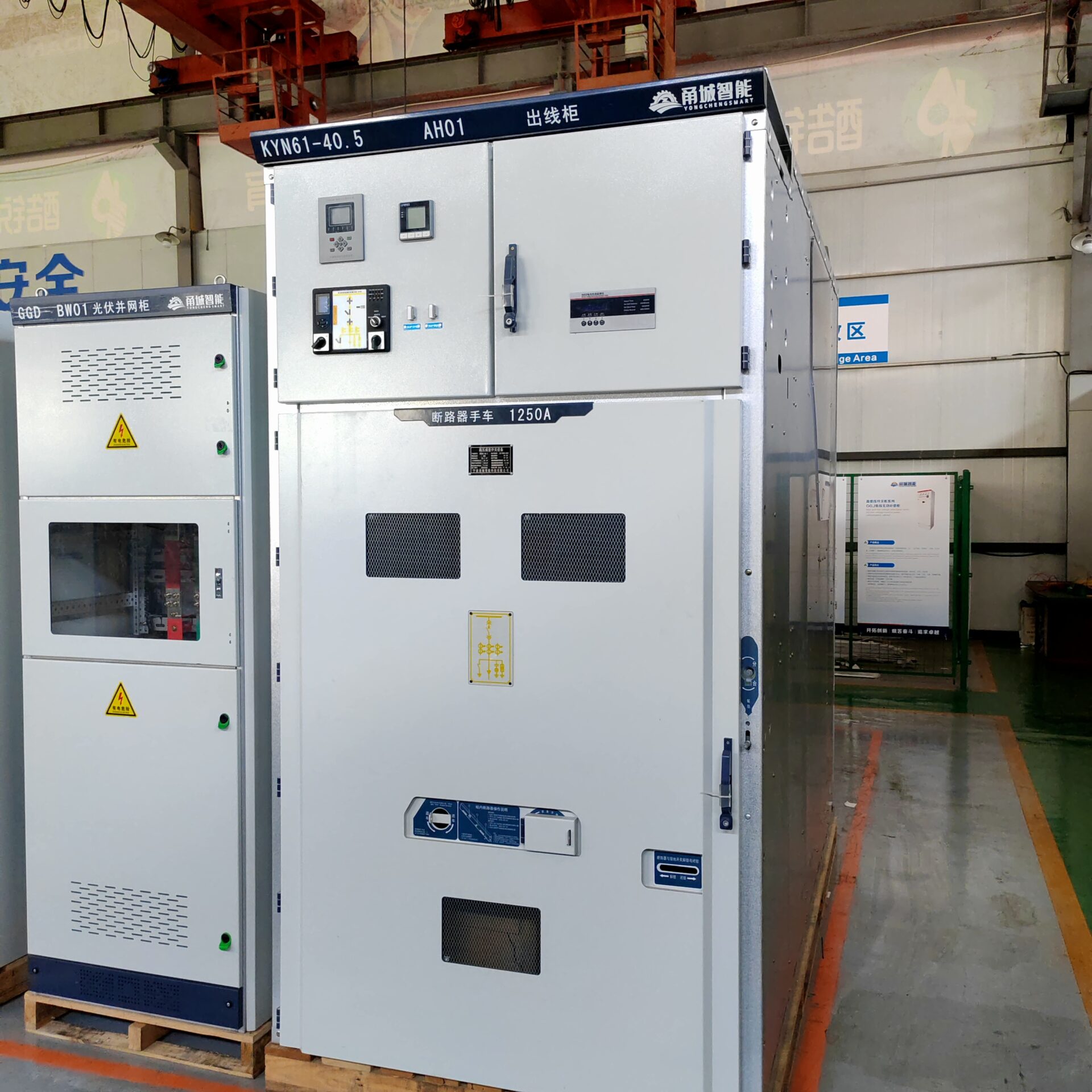
KYN61-40.5 is a commonly used model designation for metal-clad switchgear designed around a 40.5kV rated voltage, making it relevant to 35kV-class power distribution systems. For buyers facing space limitations and demanding safety requirements, its structured cabinet arrangement can provide an organized approach to high-voltage distribution and protection.
One important advantage of this type of switchgear is its compartmentalized construction. Different functional sections can be separated to improve operational safety and maintenance organization. A typical configuration may include compartments for the circuit breaker, busbars, cable connections, and low-voltage/control components.
For users, this structure can make inspection and maintenance more manageable compared with less organized electrical assemblies. It also supports clearer isolation between high-energy components and control sections.
Another important consideration is operator safety. High voltage equipment must minimize the possibility of accidental contact with energized parts and reduce the consequences of incorrect operation. Interlocking systems can help ensure that specific operations occur only under permitted conditions.
KYN61-40.5 can also be configured for different incoming, outgoing, metering, transformer, and feeder requirements, depending on the project design and manufacturer’s engineering capability. This flexibility is valuable when a standard product cannot fully match the customer’s one-line diagram.
However, selecting KYN61-40.5 should still involve careful evaluation of rated current, short-circuit withstand capability, protection scheme, environmental conditions, cable arrangement, control voltage, dimensions, and installation requirements.
For procurement teams, the goal should be a complete technical match rather than simply choosing a model number. Working with an experienced switchgear manufacturer can help ensure that the final configuration is compatible with the overall 35kV distribution system.
How Should You Compare High Voltage Switchgear Manufacturers Before Buying?
Selecting the right switchgear manufacturer is just as important as selecting the right switchgear type. Two products with similar voltage ratings can differ significantly in engineering quality, component selection, testing, customization, and after-sales support.
Start with the manufacturer’s technical capability. The supplier should understand the project’s single-line diagram, rated voltage, rated current, short-circuit level, environmental conditions, protection requirements, and installation method. A professional manufacturer should be able to translate these requirements into an appropriate switchgear configuration instead of simply offering a standard cabinet.
Next, examine manufacturing quality and testing procedures. High voltage switchgear must be manufactured with consistent mechanical tolerances, reliable electrical connections, appropriate insulation distances, and accurate internal wiring. Routine testing and documented inspection procedures are important parts of quality assurance.
Component sourcing also matters. The circuit breaker, protection relay, CTs, VTs, busbars, terminals, and control devices should be selected according to the project requirements. Buyers should confirm the technical specifications and compatibility of major components before placing an order.
Customization capability is another important factor. 35kV distribution projects may require different feeder arrangements, cable entries, metering sections, relay configurations, communication interfaces, or cabinet dimensions. A capable manufacturer should be able to adapt the design while maintaining electrical safety and performance.
Finally, consider documentation and after-sales support. Technical drawings, wiring diagrams, test reports, operating instructions, and maintenance information can make installation and commissioning significantly easier.
A reliable switchgear manufacturer should therefore provide more than a cabinet. The supplier should deliver a complete engineered solution covering design, components, production, testing, documentation, and technical support.
What Should Buyers Check Before Ordering High Voltage Switchgear?
Before placing an order, procurement teams should confirm the complete technical specification rather than relying only on the product name. Important parameters include rated voltage, rated current, insulation level, short-circuit breaking capacity, short-time withstand current, peak withstand current, protection functions, enclosure configuration, and installation conditions.
Project-specific requirements should also be reviewed carefully. For example, the available installation area may influence the cabinet dimensions and arrangement. Limited maintenance space may require a design that gives engineers practical access to operating mechanisms, cable compartments, and control components.
Environmental conditions are equally important. Temperature, humidity, altitude, dust, corrosive atmosphere, and indoor or outdoor installation can all influence equipment selection. The switchgear should be specified according to the actual service environment rather than an assumed standard condition.
The protection system deserves special attention. Circuit breakers, protection relays, CTs, VTs, and interlocking systems must work together as one coordinated system. A technically good component can still produce poor system performance when it is incorrectly selected or integrated.
Buyers should also confirm whether the switchgear manufacturer can provide factory testing, inspection records, technical drawings, and commissioning support.
For KYN61-40.5 projects, checking the complete interface between the switchgear and upstream/downstream equipment is particularly important. Transformers, cables, busbars, protection systems, and automation equipment all need to be considered together.
A detailed pre-order checklist can prevent expensive modifications later and help ensure that the delivered high voltage switchgear meets the actual project requirements.
What Makes High Voltage Switchgear a Long-Term Investment?
The value of high voltage switchgear should be measured across its entire service life, not only by its initial purchase price. A lower-cost cabinet may become more expensive if it requires frequent maintenance, difficult troubleshooting, premature component replacement, or lengthy outage periods.
A well-engineered system can help reduce these risks through reliable insulation, robust mechanical construction, effective protection, clear compartmentalization, and maintainable component layouts.
Operational convenience also contributes to lifecycle value. When operators can clearly understand the status of a feeder, safely isolate equipment, and access control components efficiently, maintenance work can be completed more systematically.
Another factor is expandability. Power distribution systems may change as production capacity grows, new loads are added, or renewable-energy equipment is integrated. A switchgear solution that can accommodate future engineering requirements may reduce the need for major modifications.
Digital communication is also becoming increasingly valuable. When protection and measurement information can be integrated into a monitoring system, operators gain better visibility into equipment status and electrical performance.
For procurement teams, the right approach is therefore to evaluate technical reliability, safety, maintainability, compatibility, customization, and lifecycle cost together.
The best switchgear specification is not simply the one with the lowest quotation. It is the one that matches the electrical system, operating environment, safety requirements, and long-term maintenance strategy.
Conclusion
For 35kV-class distribution systems, high voltage switchgear must balance safety, reliability, space, maintainability, and system compatibility. KYN61-40.5 offers a structured solution for demanding applications, while the right switchgear manufacturer can provide the engineering, customization, testing, and support needed for dependable long-term operation.
 Tiếng Việt
  English (UK)
  Bahasa Indonesia
  Deutsch
  Español
  Français
  Português
  Русский