
How Can an Electronic Energy Meter Improve Power Monitoring Accuracy and Energy Management?
Unstable grid connection protection, poor compatibility with different energy storage inverters, and complicated maintenance remain major challenges in modern power systems. Frequent switching between utility power and energy storage systems can increase the risk of equipment faults, inaccurate energy measurement, and unnecessary downtime. These issues may lead to higher operating costs, reduced system reliability, and inefficient energy management. Fortunately, a modern Electronic Energy Meter provides precise power measurement, real-time monitoring, and seamless integration with various electrical systems. Understanding how it works and selecting the right model can significantly improve operational efficiency and long-term energy performance.
An Electronic Energy Meter is a digital device designed to accurately measure electrical energy consumption in residential, commercial, and industrial power systems. Unlike traditional mechanical meters, it continuously samples voltage and current, processes the data through electronic circuits and microprocessors, and calculates electricity usage in kilowatt-hours (kWh). Advanced models, including the Three-phase Four-wire Electronic Energy Meter and Three-phase Four-wire DIN Rail Electronic KWh Meter, also provide real-time monitoring, communication capabilities, event recording, and high measurement accuracy, making them essential components in modern smart grids and energy management systems.
Curious about how an Electronic Energy Meter achieves such precision and why it has become the preferred solution for modern electrical systems? Continue reading to explore its working principles, types, advantages, and internal structure.
How Does an Electronic Energy Meter Work?
An Electronic Energy Meter measures electricity consumption by continuously monitoring both the voltage and current flowing through an electrical circuit. Unlike conventional electromechanical meters that rely on rotating aluminum discs, electronic meters utilize sophisticated sensing components, integrated circuits, and microprocessors to perform highly accurate calculations.
The measurement process begins with voltage sensors and current transformers (CTs) or shunt resistors. These components detect the electrical parameters without interrupting the normal operation of the circuit. Analog signals are then converted into digital signals through an Analog-to-Digital Converter (ADC). The embedded microprocessor samples these signals thousands of times every second, calculates instantaneous power, and integrates the data over time to determine total energy consumption in kilowatt-hours (kWh).
Modern Electronic Energy Meters also compensate for variations caused by harmonics, voltage fluctuations, and changing power factors. This ensures reliable readings even under complex electrical conditions found in industrial facilities, renewable energy installations, and commercial buildings.
Many advanced meters feature LCD displays that provide real-time information such as voltage, current, active power, reactive power, frequency, power factor, and accumulated energy. Communication interfaces such as RS485, Modbus RTU, Ethernet, or wireless communication enable remote monitoring and integration with Building Management Systems (BMS), SCADA platforms, and Energy Management Systems (EMS).
For renewable energy applications, particularly photovoltaic and battery storage systems, the Three-phase Four-wire Electronic Energy Meter supports bidirectional measurement, allowing users to accurately record both imported and exported electricity. This capability is particularly valuable for smart grid integration, net metering, and distributed energy resources.
As digital processing technology continues to evolve, today’s Electronic Energy Meter delivers exceptional accuracy, stable long-term performance, reduced maintenance requirements, and comprehensive energy analytics that help users optimize electricity consumption.
What Are the Types of Electronic Energy Meters?
The wide range of electrical installations requires different types of Electronic Energy Meter to meet varying voltage levels, wiring methods, installation environments, and monitoring requirements.
The simplest type is the Single-phase Electronic Energy Meter, commonly installed in residential homes and small commercial buildings where the electrical supply consists of one live conductor and one neutral conductor. It provides accurate measurement for standard household electricity consumption while supporting compact installation and low maintenance.
For larger commercial buildings, factories, shopping centers, and public infrastructure, the Three-phase Four-wire Electronic Energy Meter is the preferred solution. Designed for three-phase electrical networks with a neutral conductor, it measures energy consumption across all three phases simultaneously. This configuration offers balanced load monitoring, improved measurement accuracy, and enhanced operational reliability.
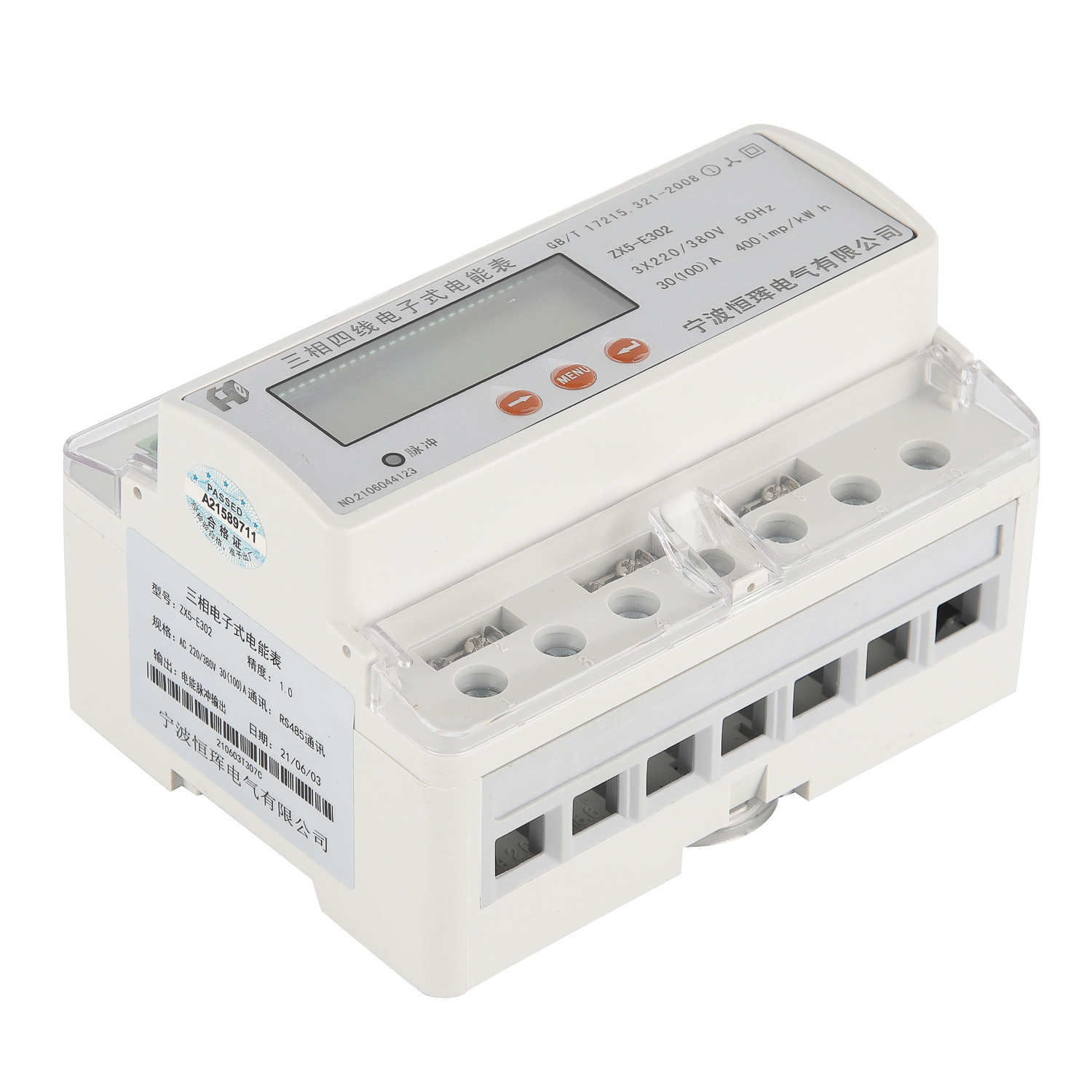
A specialized version is the Three-phase Four-wire DIN Rail Electronic KWh Meter. Built with a compact DIN rail mounting design, this meter can be easily installed inside distribution boards and electrical cabinets. Its space-saving structure simplifies installation while maintaining high measurement precision. It is widely used in industrial automation, smart buildings, renewable energy systems, and equipment sub-metering.
Electronic energy meters can also be categorized according to their functional capabilities:
- Direct-connected Electronic Energy Meter for lower current applications.
- CT-operated Electronic Energy Meter for high-current industrial systems.
- Multifunction Electronic Energy Meter capable of measuring voltage, current, frequency, active power, reactive power, apparent power, power factor, demand, and harmonic data.
- Smart Electronic Energy Meter supporting remote communication, cloud monitoring, automatic meter reading (AMR), and advanced data analysis.
- Prepaid Electronic Energy Meter allowing users to purchase electricity before consumption.
- Bidirectional Electronic Energy Meter designed specifically for photovoltaic, wind power, and battery energy storage applications.
Each meter type addresses different operational needs, but all share the common objective of delivering precise, reliable, and intelligent energy measurement for modern electrical systems.
What Are the Features, Advantages of Electronic Energy Meter and Aspects That Remain to Be Improved?
The growing adoption of the Electronic Energy Meter is driven by its superior performance compared with traditional induction meters. Modern digital technology enables greater accuracy, improved functionality, and seamless integration into intelligent energy management systems.
One of its most significant features is high measurement accuracy. Electronic measurement algorithms minimize errors caused by mechanical wear, temperature variations, and changing electrical loads. Many meters achieve Class 0.2S or Class 0.5S accuracy, making them suitable for utility billing, industrial measurement, and commercial energy management.
Another important advantage is real-time monitoring. Users can instantly view electrical parameters including voltage, current, frequency, active power, reactive power, apparent power, demand, and power factor. This continuous visibility enables faster fault diagnosis and improved operational decision-making.
Communication capability is another key strength. Modern Electronic Energy Meter products support protocols such as Modbus RTU, RS485, Ethernet, and wireless communication, allowing seamless integration into SCADA systems, Building Management Systems, and cloud-based energy management platforms.
The Three-phase Four-wire Electronic Energy Meter is particularly valuable in industrial facilities because it accurately measures unbalanced three-phase loads while supporting bidirectional energy measurement for renewable energy systems. Similarly, the Three-phase Four-wire DIN Rail Electronic KWh Meter offers compact installation, flexible deployment, and simplified cabinet integration.
Additional benefits include:
- Long service life with no moving mechanical components.
- Low maintenance requirements due to solid-state electronic design.
- Remote data collection that reduces manual meter reading.
- Event recording for voltage interruptions, overloads, and abnormal operating conditions.
- Tamper detection to improve billing security.
- Excellent compatibility with modern smart grid infrastructure.
Despite these advantages, certain areas still require continuous improvement. Cybersecurity has become increasingly important as more meters connect to communication networks. Protection against unauthorized access and data manipulation must continue evolving alongside digital infrastructure.
Interoperability between manufacturers can also be enhanced through wider adoption of standardized communication protocols. Additionally, although costs have steadily decreased, advanced multifunction smart meters remain more expensive than basic models, which may limit adoption in cost-sensitive markets.
Future developments are expected to focus on AI-assisted analytics, predictive maintenance, edge computing, enhanced cybersecurity, and even deeper integration with distributed renewable energy resources.
What Is the Structure of Electronic Energy Meter?
The internal structure of an Electronic Energy Meter is carefully engineered to ensure long-term reliability, high measurement precision, and stable operation under diverse electrical conditions.
At the front end, the meter contains voltage sensing circuits и current sensing circuits. These components continuously collect electrical signals from the power network while maintaining electrical isolation and measurement safety. Depending on the application, current measurement may use shunt resistors, current transformers (CTs), or Rogowski coils.
The collected analog signals are processed by a high-speed Analog-to-Digital Converter (ADC). Accurate digital sampling forms the basis for precise energy calculation and enables the meter to perform sophisticated mathematical processing.
The core processing unit is the microprocessor or dedicated metering integrated circuit (IC). This component executes complex algorithms to calculate active energy, reactive energy, apparent energy, demand values, power quality parameters, and other electrical variables. It also manages event recording, communication, display functions, and system diagnostics.
The calculated information is stored in non-volatile memory, ensuring that billing data remains secure even during power outages. Many meters include real-time clocks to timestamp recorded events and support time-of-use (TOU) tariff calculations.
A clear LCD display provides local access to operating information such as accumulated kWh, voltage, current, frequency, power factor, and communication status.
Communication modules represent another essential structural component. Interfaces including RS485, Modbus, Ethernet, M-Bus, Wi-Fi, NB-IoT, and LoRa enable remote data acquisition and centralized energy management.
For industrial installations, the Three-phase Four-wire DIN Rail Electronic KWh Meter integrates all these components into a compact DIN rail enclosure that simplifies installation within electrical distribution panels.
Additional protective circuits safeguard the meter against surge voltage, electromagnetic interference, overload conditions, and environmental influences. Combined with robust housing materials and precision manufacturing, these structural elements ensure reliable operation throughout the meter’s service life while supporting increasingly intelligent energy management applications.
Conclusion
An Electronic Energy Meter delivers highly accurate energy measurement, intelligent monitoring, and reliable communication for today’s electrical systems. Whether selecting a Three-phase Four-wire Electronic Energy Meter or a Three-phase Four-wire DIN Rail Electronic KWh Meter, choosing the appropriate solution helps improve energy efficiency, simplify management, and support the growing demands of modern smart power networks.
 Русский
  English (UK)
  Bahasa Indonesia
  Tiếng Việt
  Deutsch
  Español
  Français
  Português