
Is Cable Tray a Better Choice for Modern Electrical System Installations?
Cable management can become difficult when an Electrical System contains many cable routes, frequent branch connections, and future expansion requirements. Too many fittings make field cutting and drilling inconvenient, while alignment during splicing can consume significant installation time. Corrosion protection can also be damaged during fabrication. At the same time, designers must balance cable heat dissipation with protection and shielding, while later cable additions, removals, and maintenance can be difficult. These issues may increase installation costs, create safety risks, and complicate future upgrades. A properly selected cable tray system provides a practical approach to organized, accessible, and adaptable cable management.
What Is a Cable Tray?
According to the National Electrical Code standard of the United States, a cable tray is a unit or assembly of units or sections and associated fittings forming a rigid structural system used to securely fasten or support cables and raceways. In practical applications, a cable tray provides a structured route for power, control, communication, and other cables while maintaining orderly cable arrangement and accessibility. Depending on project requirements, systems may use ladder, perforated, solid-bottom, or other tray configurations.
The choice of cable management method can directly influence installation efficiency, protection, maintenance, and future expansion.
Is Cable Tray Better Than Conduit?
A cable tray is not universally better than conduit. The more appropriate question is whether a cable tray provides better overall performance for a particular Electrical System, environment, and cable arrangement. In many commercial, industrial, infrastructure, and utility applications, cable tray can provide significant advantages over traditional conduit, particularly when a project involves a large number of cables or expects future modifications.
One major advantage is installation efficiency. Conduit normally requires individual lengths, bends, couplings, fittings, and carefully planned routing. When a route changes, additional fabrication may be necessary. Cable tray, by comparison, provides a continuous support structure in which multiple cables can be arranged along the same route. This can reduce the number of individual containment components and make cable installation more straightforward.
Cable tray can also offer better cable accessibility. Once a conduit system is installed, accessing individual cables can require pulling operations or removing covers and fittings. A tray generally leaves cables visible and accessible from above or from the side, depending on its configuration. This can simplify inspection, replacement, troubleshooting, and future cable installation.
Another important factor is heat dissipation. A ladder-style or ventilated cable tray allows more air circulation around cables than a fully enclosed route. This can help dissipate heat, although cable ampacity must always be determined according to the applicable electrical standards, installation conditions, cable grouping, and manufacturer requirements.
However, conduit remains advantageous where cables require higher mechanical protection, environmental protection, or a fully enclosed route. Areas exposed to severe impact, moisture, contamination, or specific hazardous conditions may require an enclosed containment method or a combination of systems.
The comparison also depends on installation space. Cable tray can provide a relatively efficient route for many cables, but it requires appropriate structural support and sufficient clearance. Conduit can sometimes be easier to route through restricted spaces or around obstacles.
Therefore, the decision should consider cable quantity, environmental conditions, mechanical protection, accessibility, heat dissipation, installation cost, maintenance requirements, and future expansion. For a large and changeable Electrical System, cable tray can often provide greater flexibility. For highly exposed or enclosed routing requirements, conduit may remain the more suitable solution.
In practice, cable tray and conduit do not have to compete with each other. A well-designed project may use both. For example, cable tray can serve as the primary distribution route, while conduit can protect individual cable sections where they pass through walls, floors, machinery, or areas requiring additional protection. This combined approach can provide a more balanced cable management solution.
What Are the Types of Cable Trays?
Cable trays are available in several structural configurations, and each type is intended to address different cable management requirements. The main types commonly considered in an Electrical System include ladder cable tray, perforated cable tray, solid-bottom cable tray, wire-mesh tray, and channel-type tray. The appropriate selection depends on cable type, load, ventilation, protection, installation environment, and maintenance requirements.
1. Cable Ladder
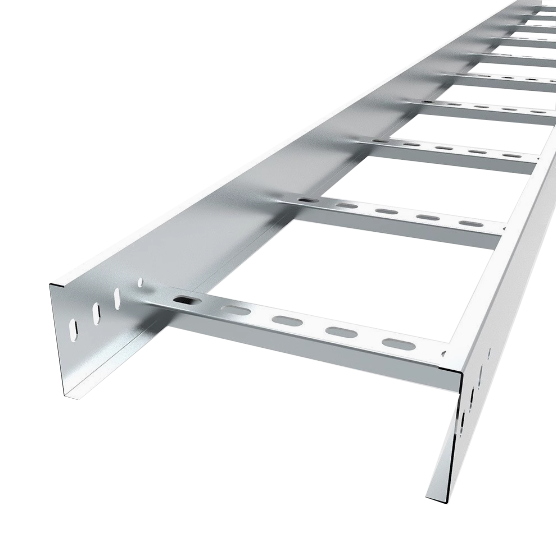
A cable ladder consists primarily of two longitudinal side rails connected by regularly spaced cross members. Its open structure provides strong mechanical support while allowing substantial airflow around the cables.
Cable ladder is particularly suitable for applications involving large power cables, heavy cable loads, and long cable routes. Because the structure is open, heat generated by cables can dissipate efficiently. The cross members can also provide convenient points for securing and organizing cables.
For industrial facilities, substations, utility projects, and large infrastructure systems, cable ladder is often considered when cable quantity and cable weight are significant. It can also provide convenient access for inspection and future cable additions.
2. Perforated Cable Tray
A perforated cable tray generally consists of a tray-shaped base with regularly distributed openings. The openings provide ventilation while retaining more physical support around the cable route than a completely open ladder structure.
This configuration offers a balance between cable support, ventilation, protection, and accessibility. It can be used for power, control, instrumentation, and other electrical cables, depending on the project design.
3. Solid-Bottom Cable Tray
A solid-bottom cable tray provides a continuous base underneath the cables. Compared with open configurations, it can offer greater protection from falling particles and can help keep smaller cables organized.
However, because ventilation is more limited, heat dissipation requires particular consideration. Cable loading and thermal conditions should therefore be evaluated carefully before selecting this configuration.
4. Wire-Mesh Cable Tray
Wire-mesh cable tray uses a welded wire structure to support cables. Its lightweight design and open construction can make it convenient for smaller cables, communication cables, control cables, and applications requiring frequent changes.
Its flexibility can be particularly useful where cable routes contain many branches or where installation teams expect frequent modifications.
5. Channel Cable Tray
Channel-type systems provide a compact cable support solution for smaller cable groups. They can be suitable where a full-width tray is unnecessary but organized cable routing is still required.
In some installations, cable trunking may also be used as an alternative or complementary containment method. Cable trunking generally provides a more enclosed route, whereas cable tray normally emphasizes accessible support and ventilation.
The selection should therefore not be based only on the physical appearance of the tray. Load capacity, span, cable dimensions, corrosion resistance, installation environment, support spacing, ventilation, and future expansion all need to be considered. Different materials and surface treatments may also be selected according to environmental conditions.
For projects exposed to humidity, chemicals, salt spray, or outdoor conditions, corrosion resistance becomes especially important. Protective coatings and suitable materials can help extend service life, but field cutting, drilling, or fabrication should be managed carefully because improperly treated areas may reduce corrosion protection.
A well-selected cable tray system should ultimately provide a combination of mechanical stability, organized routing, accessibility, ventilation, and long-term adaptability.
What Is the Difference Between Cable Duct and Cable Tray?
Cable duct and cable tray both organize and support cables, but their structures and typical applications are different. The main distinction is that a cable tray is generally an open or ventilated support system, while a cable duct or cable trunking system normally provides a more enclosed pathway for cables.
A cable tray is designed primarily to support cables along a defined route. Depending on the configuration, cables remain visible and accessible. This makes cable tray particularly useful where a large number of cables must be installed, inspected, replaced, or expanded over time.
A cable duct generally provides greater enclosure. Its walls or cover can help protect cables from external contact, dust, falling objects, and other environmental influences. This can make cable duct or cable trunking appropriate for installations where cables require additional physical separation or protection.
The difference also affects heat dissipation. Open cable tray configurations, especially cable ladder, provide strong natural airflow around cables. Enclosed cable ducts may restrict airflow, so thermal conditions can become a more important design consideration.
Accessibility is another major difference. Cable tray allows technicians to visually identify cables and generally makes cable additions relatively convenient. Cable duct may require opening a cover or accessing a confined internal space before cables can be installed or serviced.
At the same time, an enclosed cable duct can provide a cleaner appearance. In commercial or architectural areas where exposed cables would affect visual presentation, cable trunking can offer a more concealed routing solution.
The two systems can also be combined. For example, a project may use a main cable tray for distribution throughout a plant and then transition to cable duct or conduit when cables approach individual machines or enter areas requiring greater protection.
The choice should therefore be based on the function of the cable route rather than simply the containment product itself. Where ventilation, accessibility, large cable quantities, and future expansion are priorities, cable tray can be highly effective. Where enclosure, cleanliness, or protection from external contact is more important, cable duct or cable trunking may be preferable.
Cable ladder is another useful distinction. It is technically a type of cable tray structure, but its open ladder-like configuration is particularly suited to heavy cable loads and applications where ventilation is important.
For an Electrical System with multiple cable routes, a combination of cable tray, cable ladder, cable duct, cable trunking, and conduit can often create a more practical overall routing strategy. The key is to match each containment method with its specific operating environment and cable requirements.
When to Use Cable Trays?
Cable tray is particularly suitable when an Electrical System contains multiple cables that need to follow organized and accessible routes. It is widely considered for industrial facilities, commercial buildings, power distribution installations, infrastructure projects, data-related facilities, renewable energy projects, and other applications where cable quantities can grow over time.
One of the strongest reasons to use cable tray is high cable density. Instead of creating separate conduit routes for numerous individual cables, a properly designed tray can support multiple cables along a common pathway. This can simplify route planning and reduce the number of individual containment components.
Cable tray is also valuable when future expansion is expected. Electrical systems are rarely completely static. Additional equipment, control circuits, communication lines, and power cables may be required as a facility expands. An accessible tray system can make future cable installation more manageable because spare capacity can be planned into the original design.
Maintenance is another important consideration. Technicians may need to identify cables, inspect their condition, replace damaged cables, or modify circuits. Because cable tray generally keeps cables accessible, maintenance teams can work with greater visibility than in many fully enclosed routing systems.
Cable tray can also be considered when heat dissipation is important. Open structures such as cable ladder provide airflow around cables, which can be beneficial for thermal management. Nevertheless, cable loading, cable grouping, ambient temperature, installation method, and applicable electrical requirements must be evaluated rather than assuming that an open tray automatically eliminates thermal limitations.
Environmental conditions should also guide the decision. Outdoor and industrial installations may expose cable trays to moisture, chemicals, dust, ultraviolet radiation, or salt spray. In these situations, appropriate material selection and corrosion protection are essential. The installation method should also avoid unnecessary damage to protective coatings.
Cable tray is especially useful when installation efficiency is a priority. Compared with systems requiring extensive conduit bending and individual routing, a tray can provide a more direct pathway for groups of cables. This can simplify installation planning and support faster project execution.
However, cable tray is not appropriate for every situation. Where cables need a highly enclosed route, where severe mechanical protection is required, or where specific environmental or safety requirements apply, conduit or cable duct may be more appropriate.
For this reason, the best approach is usually to evaluate the complete routing strategy before selecting the containment method. Cable quantity, cable size, cable type, load, environment, accessibility, structural support, fire and safety requirements, corrosion conditions, and future expansion should all be included in the design assessment.
A properly engineered cable tray system should also include suitable fittings and supports. Straight sections alone are not enough for a complete installation. Bends, tees, reducers, supports, connectors, covers, and other associated components may be required depending on the route.
For projects where quality and long-term reliability are important, component compatibility and installation quality are equally significant. Protective treatment should remain intact, support spacing should be appropriate for the expected load, and cables should be arranged without creating unnecessary stress or excessive concentration.
Ultimately, cable tray is most valuable when an Electrical System requires organized cable distribution, accessible maintenance, efficient installation, ventilation, and flexibility for future changes. Selecting the correct tray type and designing the complete support system are essential to achieving these benefits.
Conclusion
A cable tray provides an organized, accessible, and adaptable approach to cable management. Compared with conduit, cable tray can offer advantages in installation, ventilation, maintenance, and expansion. Cable ladder, cable trunking, and cable duct can complement it where different protection or routing requirements exist, creating a practical solution for modern Electrical System projects.
 Español
  English (UK)
  Bahasa Indonesia
  Tiếng Việt
  Deutsch
  Français
  Português
  Русский