
How Can Buyers Choose a Perforated Cable Tray That Balances Strength, Protection, and Easy Installation?
A perforated cable tray can offer ventilation and convenient cable routing, but the holes that improve accessibility can also introduce practical risks. Excessive perforation may reduce mechanical strength, collect dust and debris, expose hole edges to corrosion, and provide weaker protection against dust and electromagnetic interference. Small wires can also become caught in openings, while non-standard hole patterns may limit accessory compatibility. These problems can increase installation time, maintenance work, cable damage risks, and replacement costs. The right perforated cable tray addresses these concerns through appropriate material, structural design, dimensions, surface protection, and compatible accessories. The following guide explains what buyers should evaluate before placing an order.
Table of Contents
ToggleWhat Is a Perforated Cable Tray?
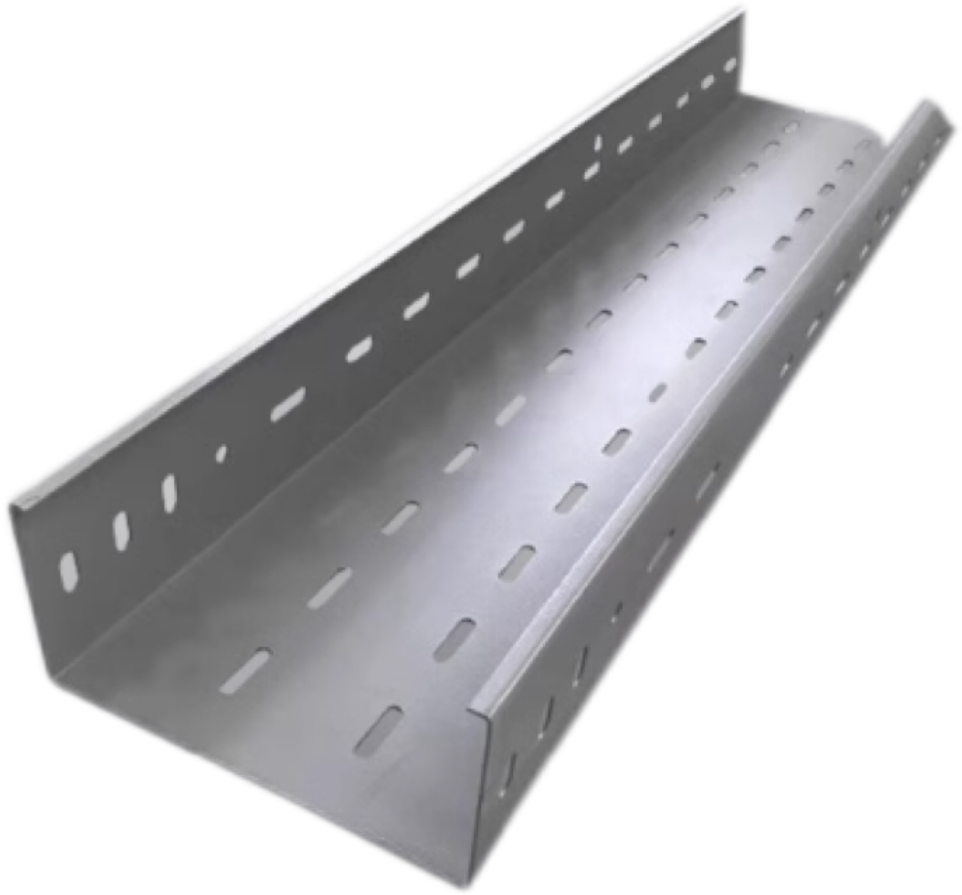
A perforated cable tray is a metal channel support system with uniformly spaced holes or slots along the bottom and side rails, designed to route, organize, support, and ventilate electrical and data cables. Compared with a solid-bottom cable tray, its openings improve airflow, reduce cable heat accumulation, provide convenient access for fastening, and allow flexible cable entry and exit. A properly selected perforated cable tray combines mechanical strength, corrosion resistance, suitable load capacity, and installation compatibility. For project buyers, the key is not simply the number of holes, but whether the tray’s structure, material, dimensions, surface treatment, and accessories match the actual electrical installation environment.
The basic concept is simple, but selecting the right tray requires a closer look at tray types, structural differences, dimensions, and applications.
What Are the Three Main Types of Cable Trays Buyers Should Know?
Cable trays are commonly divided into ladder-type, perforated-type, and solid-bottom cable trays. Each design has a different balance between ventilation, protection, accessibility, weight, and installation convenience.
A ladder-type cable tray consists primarily of two longitudinal side rails connected by regularly spaced cross members. The open structure provides excellent ventilation and makes cable installation, inspection, and maintenance convenient. It is particularly suitable where heat dissipation and cable accessibility are major priorities. Because cables are supported at intervals rather than continuously across the bottom, the design is also relatively lightweight while maintaining substantial mechanical strength.
A perforated cable tray has a continuous metal base and side walls containing regularly distributed holes or slots. This structure provides more continuous cable support than a ladder tray while retaining ventilation and allowing cables to be secured at convenient positions. It offers a practical balance between support, airflow, cable organization, and accessibility, making it suitable for many electrical distribution and control installations.
A solid-bottom cable tray uses a continuous, unperforated base. It provides stronger physical shielding and better containment of small cables, dust, and falling debris than highly open designs. However, ventilation is more limited, so heat management and cable loading need greater attention.
For purchasing decisions, there is no universally superior type. A cable tray manufacturer or cable tray producer should first understand the project’s cable type, cable quantity, environment, support span, loading requirements, and protection expectations. The buyer can then select the structure that offers the best balance between installation requirements and long-term operating conditions.
In environments where ventilation is important but continuous cable support is still required, the perforated design can be a particularly practical choice.
What Are the Key Differences Between a Ladder-Type Cable Tray and a Perforated Cable Tray?
The most important difference is their support structure. A ladder-type tray uses side rails and cross rungs, while a perforated cable tray uses a continuous perforated base. This basic structural distinction affects cable support, ventilation, installation, and maintenance.
| Característica | Ladder-Type Cable Tray | Perforated Cable Tray |
|---|---|---|
| Bottom structure | Open, with cross rungs | Continuous base with openings |
| Ventilation | Excellent | Very good |
| Cable support | Intermittent | More continuous |
| Small cable support | Less suitable in some installations | Generally more convenient |
| Cable fastening | Fastening to rungs | Fastening through tray openings |
| Heat dissipation | Excellent | Good to very good |
| Physical containment | Lower | Higher |
| Cleaning | Easy access | Requires cleaning around openings |
| Typical advantage | High ventilation and heavy cable routing | Balance of support, ventilation, and protection |
For large power cables, the ladder structure can be advantageous because its open design supports strong airflow and makes cable placement and inspection straightforward. It is also convenient when cables need to be arranged in multiple layers or when frequent access is expected.
A perforated tray, by contrast, provides a more continuous surface underneath the cables. This can be useful for control cables, communication cables, instrumentation cables, and mixed cable arrangements where more consistent support is desirable. The holes also provide multiple fastening points, allowing installers to secure cables without drilling additional openings into the tray.
However, perforation must be properly engineered. A tray with excessive or poorly positioned openings may have lower rigidity, particularly around joints and load-bearing areas. Hole dimensions should also be appropriate for the intended cable sizes. If openings are too large relative to the cables, thin wires may pass through or become caught.
Surface treatment is another important consideration. Since perforated edges can expose more metal surface, corrosion protection becomes especially important in humid, coastal, chemical, or outdoor environments.
Accessory compatibility should also be considered. A reliable cable tray seller should be able to clarify whether bends, tees, crosses, couplers, supports, covers, clamps, and other accessories are designed to work with the selected tray dimensions and hole pattern.
Therefore, the comparison should not stop at appearance. Buyers should evaluate load capacity, material thickness, hole configuration, corrosion resistance, support spacing, cable type, and accessory compatibility before selecting either design.
What Are the Standard Sizes of Perforated Cable Trays?
There is no single universal size that applies to every perforated cable tray project. Tray dimensions are normally selected according to cable quantity, cable diameter, installation space, support span, load, and future expansion requirements.
Width is one of the first dimensions buyers should determine. Common project configurations may include widths such as 50 mm, 100 mm, 150 mm, 200 mm, 300 mm, 450 mm, 600 mm, 750 mm, and 900 mm, although actual available sizes vary by manufacturer, standard, and market.
Tray height is another important dimension. Typical side-wall heights can range from approximately 50 mm to 150 mm or more, depending on the required cable capacity and structural requirements. A deeper tray may provide greater cable containment, but increasing height does not automatically mean that the tray is suitable for a heavier load.
Length also affects procurement and installation. Straight tray sections are commonly supplied in standardized lengths, often around 2 m or 3 m, depending on the producer and regional requirements. Standardized lengths can simplify transportation, jointing, cutting, and site installation.
For buyers, choosing dimensions based only on the current cable quantity is not always economical. A better approach is to consider future cable expansion, installation clearance, bending radius, heat dissipation, and maintenance access. Overcrowding a tray can make installation difficult and may affect thermal performance. At the same time, choosing an excessively wide tray can increase material cost and occupy valuable installation space.
Material thickness should be considered together with dimensions. A wider tray with a longer support span may require greater thickness or additional structural reinforcement to maintain rigidity. The actual load capacity depends on the complete design, including material, thickness, tray profile, support spacing, connection method, and installation direction.
Hole dimensions and spacing are also part of the specification. Regular openings make cable fastening convenient, but the pattern should provide sufficient support without unnecessarily weakening the tray.
For project procurement, buyers should therefore provide a complete dimensional specification rather than simply asking for a “standard perforated cable tray.” A professional cable tray manufacturer should confirm width, height, length, material, thickness, surface treatment, hole pattern, loading requirements, accessories, and installation conditions before final quotation.
This approach helps prevent a common purchasing problem: receiving a tray that technically matches the requested width but does not provide the required structural performance or installation compatibility.
What Are the Key Uses and Applications of Perforated Cable Tray?
Perforated cable trays are used primarily to provide a structured route for electrical, control, instrumentation, and data cables. Their combination of a continuous support base and ventilation openings makes them adaptable to many cable-management environments.
In industrial facilities, perforated trays can be used to organize power cables, control cables, instrumentation wiring, and auxiliary electrical circuits. Organized routing reduces cable disorder and makes inspection easier. Where production equipment is distributed across a large facility, properly planned tray routes can also simplify future maintenance and cable replacement.
In commercial buildings, perforated cable trays can support electrical distribution and low-voltage cabling in ceiling spaces, technical rooms, service corridors, and other areas requiring organized cable management. Their relatively open construction allows ventilation while maintaining a defined cable route.
In data and communication installations, cable organization is particularly important. Perforated trays can help maintain separation and orderly routing for communication and data cables, provided the selected system meets the project’s electromagnetic, fire, loading, and installation requirements.
In power distribution systems, the tray provides mechanical support and a controlled pathway for cables between electrical equipment and distribution points. Cable routing can be planned around bends, vertical transitions, branches, and equipment connections using compatible tray accessories.
Perforated trays are also useful in workshops, warehouses, factories, infrastructure projects, and building service systems where cables need continuous support combined with airflow and convenient fastening.
However, the operating environment determines whether a particular perforated cable tray is appropriate. Indoor dry environments generally place fewer demands on surface protection than outdoor or corrosive locations. In humid or coastal environments, corrosion-resistant materials or protective surface treatments may be necessary. In dusty environments, the openings should be considered carefully because accumulated dust can affect cleaning requirements and long-term maintenance.
Cable type also matters. Small control or communication cables may require smaller openings or additional support to prevent cables from passing through the perforations. Larger power cables require adequate load capacity, bending space, and fastening arrangements.
Another important application consideration is electromagnetic compatibility. A perforated tray does not provide the same shielding characteristics as a completely enclosed metallic system. Where electromagnetic interference is a major concern, buyers should evaluate the complete cable-management design rather than assuming that perforation alone provides adequate protection.
For this reason, a professional cable tray producer should consider the tray as part of the complete electrical installation rather than as an isolated metal component. The final selection should account for cable type, quantity, environmental conditions, support arrangement, installation space, required protection, and applicable project specifications.
How Should Buyers Evaluate a Perforated Cable Tray Supplier?
Choosing the tray is only part of the procurement decision. The cable tray manufacturer or supplier should also be evaluated for manufacturing capability, quality control, customization, dimensional consistency, surface treatment, accessory availability, and communication efficiency.
A capable supplier should be able to provide clear technical specifications covering material, thickness, width, height, length, hole pattern, surface treatment, load requirements, and accessories. Consistent dimensions are particularly important because tray sections need to connect correctly during installation.
Buyers should also confirm whether the supplier can produce customized sizes or configurations when standard dimensions do not match the project. This may include special widths, non-standard lengths, different hole patterns, additional covers, or customized fittings.
For B2B procurement, quality consistency is often more important than simply obtaining the lowest unit price. Variations in thickness, hole positioning, surface coating, or connection dimensions can create additional installation costs at the project site.
A reliable cable tray seller should therefore provide transparent specifications and communicate clearly about production lead time, packaging, transportation, inspection, and documentation. For larger projects, buyers may also need samples or inspection arrangements before mass production.
The best procurement decision is ultimately based on total project value, not merely the initial tray price. A tray that is easier to install, better protected against corrosion, compatible with standard accessories, and consistent between batches may reduce labor, maintenance, and replacement costs over its service life.
How Can Buyers Select the Right Perforated Cable Tray for a Project?
The selection process can be simplified into several practical steps.
First, identify the cable types and quantities. Determine whether the tray will carry power, control, instrumentation, communication, or mixed cables.
Second, calculate the required tray width and height. Allow sufficient room for present cables while considering future expansion and installation access.
Third, evaluate the required load capacity and support span. Tray dimensions alone do not determine structural performance. Material thickness, tray profile, reinforcement, connection design, and support spacing should be considered together.
Fourth, assess the installation environment. Indoor, outdoor, humid, coastal, dusty, and corrosive environments can require different material or surface-treatment solutions.
Fifth, verify the hole pattern and accessory compatibility. Bends, tees, crosses, reducers, couplers, clamps, covers, and supports should work together as one system.
Finally, confirm technical documentation and production capability with the supplier. A qualified cable tray manufacturer should be able to turn the project’s technical requirements into a clear product specification before production begins.
This process reduces the risk of purchasing a tray that looks suitable in a catalogue but performs poorly under actual project conditions.
Conclusion
A perforated cable tray is valuable because it balances continuous cable support, ventilation, organization, and installation convenience. The right choice depends on material, dimensions, structural strength, corrosion protection, hole design, accessories, and application conditions. For buyers, careful specification and supplier evaluation are essential to achieving reliable long-term cable management.
 Español
  English (UK)
  Bahasa Indonesia
  Tiếng Việt
  Deutsch
  Français
  Português
  Русский