
How Can a Cooling Tower Control Cabinet Improve Cooling System Reliability and Maintenance?
Cooling tower systems can become difficult to manage when commissioning is complicated, parameters are hard to tune, and moisture causes condensation inside the cabinet. Without automatic standby-pump switching, a pump failure may interrupt cooling; without remote monitoring, faults can go unnoticed. Poor protection can also expose motors to overload, phase loss, and overheating, while unclear interfaces make troubleshooting slow. A properly designed cooling tower control cabinet integrates automation, protection, monitoring, and control to create a safer and easier-to-maintain system. Keep reading to see what features matter when selecting one.
What Is a Cooling Tower Control Cabinet?
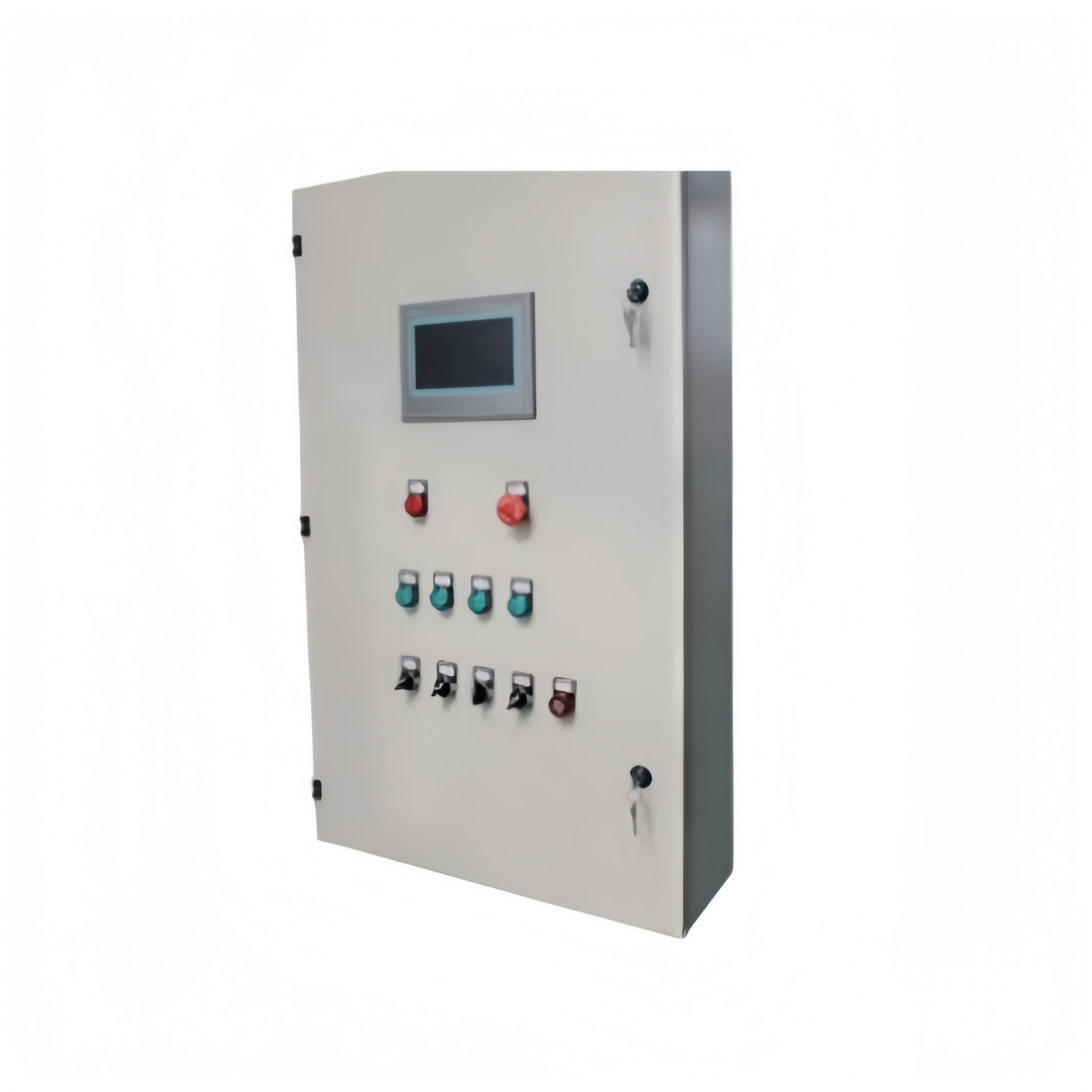
A cooling tower control cabinet is a centralized electrical enclosure that manages, monitors, and automates the operation of a cooling tower system. It typically integrates a PLC control system, motor control devices, protection components, sensors, communication interfaces, and an HMI to regulate fans, pumps, water temperature, pressure, and other operating conditions. A well-designed cooling tower control panel can provide automatic control, local operation, fault protection, alarm management, and remote monitoring, helping improve cooling efficiency, equipment safety, and maintenance convenience.
The right configuration depends on the cooling tower capacity, number of fans and pumps, motor ratings, control requirements, environmental conditions, and communication architecture.
How Does a Cooling Tower Control Cabinet Make Daily Operation Easier?
The main purpose of a cooling tower control cabinet is to transform multiple individual control tasks into one coordinated control system. Instead of manually starting and stopping fans and pumps, operators can use automatic logic to maintain the required cooling conditions.
A typical system can monitor parameters such as outlet water temperature, water pressure, liquid level, motor status, and operating alarms. Based on these signals, the controller can automatically adjust equipment operation.
For example, when the cooling-water temperature rises above the configured value, the control system can increase fan operation or start additional equipment. When the temperature returns to the desired range, unnecessary equipment can be reduced or stopped. This helps avoid continuous full-load operation.
Another important function is automatic sequencing. Pumps and fans can be started according to predefined logic rather than relying on operators to remember every operating step. This is especially useful in industrial cooling systems and central air-conditioning systems where stable operation is required for long periods.
A cooling tower control panel can also provide different operating modes, such as:
- Manual mode for commissioning and maintenance
- Automatic mode for routine operation
- Remote mode for centralized supervision or building-management systems
The operator can therefore select the appropriate control method according to the working condition.
For projects requiring more sophisticated automation, a PLC Control Panel can coordinate multiple devices and process sensor feedback through programmed control logic. This provides a more systematic solution than a conventional standalone motor-control cabinet.
The result is not simply easier operation. Properly coordinated control can also help reduce unnecessary equipment running time, improve operating consistency, and make abnormal conditions easier to identify.
What Components Should Be Inside a Cooling Tower Control Cabinet?
The internal configuration determines how reliably the cabinet can perform its control and protection functions. A professionally designed PLC control cabinet normally combines power components, control components, monitoring devices, and communication equipment into one organized enclosure.
PLC and Control System
The PLC acts as the central control unit. It receives signals from temperature, pressure, liquid-level, and equipment-status sensors and executes programmed control logic.
For example, PLC logic can determine:
- When a cooling-water pump should start
- When a standby pump should take over
- How fans should operate according to temperature
- When an alarm should be generated
- When equipment should stop because of a serious fault
Motor Control Components
Depending on the application, the cabinet may include contactors, motor protection devices, soft starters, or variable frequency drives (VFDs).
VFDs are particularly useful when fan or pump speed needs to be adjusted instead of operating continuously at full speed. This can provide more flexible capacity control and may help reduce energy consumption when cooling demand varies.
Power Distribution and Protection
Circuit breakers and other protective devices provide isolation and electrical protection for the incoming supply and individual loads.
The cabinet can separate circuits for:
- Cooling tower fans
- Circulation pumps
- Control power
- Sensors
- Auxiliary equipment
- Communication equipment
This makes troubleshooting and maintenance more systematic.
HMI and Operator Interface
An HMI touchscreen gives operators a visual interface for viewing operating conditions, changing permitted parameters, checking alarms, and selecting control modes.
A clear interface is especially valuable during commissioning because technicians can observe equipment status and identify abnormal signals without checking every component individually.
Sensors and Communication Devices
Temperature sensors, pressure sensors, liquid-level sensors, and equipment feedback signals provide the information required for automatic control.
Communication interfaces can also connect the PLC Control Panel with a central monitoring system or building-management system, depending on the project’s requirements.
Good internal layout is equally important. Components should be arranged with clear wiring, sufficient spacing, proper labeling, and convenient maintenance access. This reduces troubleshooting time and makes future servicing easier.
How Does a Cooling Tower Control Panel Handle Different Application Scenarios?
Cooling tower control systems are used in many environments, and the control strategy should match the actual application rather than using one standard configuration for every project.
Central Air-Conditioning Systems
Large commercial buildings, hotels, shopping centers, office buildings, and other facilities may use cooling towers as part of their central air-conditioning systems.
In these applications, the control cabinet can coordinate cooling-water pumps, cooling tower fans, temperature sensors, and related equipment. Automatic control helps maintain suitable water temperatures while reducing unnecessary manual operation.
Industrial Cooling Systems
Industrial processes often generate significant amounts of heat. Manufacturing plants may use cooling towers for equipment cooling, process-water circulation, heat exchangers, and other thermal-management applications.
Here, the control system may need to operate continuously and respond quickly to changes in process conditions.
A PLC-based system can monitor multiple parameters and execute predefined sequences. If a primary pump develops a fault, the system can generate an alarm and, when configured appropriately, switch to a standby pump.
HVAC and Building Services
Cooling towers are also commonly integrated into larger HVAC systems. The cooling tower control cabinet can communicate with other building-control equipment to coordinate cooling demand.
Remote monitoring becomes particularly useful in large facilities because operators may not be physically located next to the cooling tower.
Water Circulation Systems
Where multiple pumps or fans are installed, automatic sequencing becomes increasingly important. The cabinet can distribute operating hours, manage equipment combinations, and provide fault feedback.
For projects with different motor capacities, environmental conditions, or control requirements, the cabinet can also be customized according to the electrical and automation design.
Outdoor and Humid Environments
Cooling tower installations are often exposed to moisture, humidity, temperature changes, and other harsh conditions.
For these applications, enclosure selection and protection design are important. A suitable enclosure, appropriate sealing, ventilation strategy, and anti-condensation measures can help reduce the risk of moisture-related component damage.
Therefore, when purchasing a cooling tower control panel, buyers should consider not only the electrical rating but also installation environment, control method, communication requirements, and maintenance conditions.
What Protection Functions Are Built Into a Cooling Tower Control Cabinet?
Protection is one of the most important considerations when selecting a cooling tower control cabinet. Cooling tower fans and pumps are motor-driven loads, so electrical faults can quickly lead to equipment damage or unexpected cooling-system downtime.
A properly configured cabinet can incorporate several protection functions.
Overload Protection
Motor overload occurs when a motor operates above its suitable operating condition for an extended period. Excessive current can cause overheating and accelerate insulation deterioration.
The control cabinet can use suitable motor protection devices or VFD functions to detect abnormal current conditions and disconnect or alarm the affected motor.
Short-Circuit Protection
A short circuit can create a very high fault current. Circuit breakers and appropriate protective devices are used to interrupt the fault and protect cables and electrical equipment.
Correct coordination between protective devices is essential when designing the cabinet.
Phase-Loss Protection
Three-phase motors require balanced power conditions. A missing phase can cause abnormal motor operation and overheating.
Phase-loss protection can detect this condition and prevent continued operation that could damage the motor.
Overvoltage and Undervoltage Protection
Abnormal supply voltage can affect motor performance and electrical components. Depending on the system design, voltage monitoring and protection can provide alarms or initiate protective actions when voltage moves outside configured limits.
Overtemperature Protection
Temperature monitoring can be applied to both the cooling process and selected electrical equipment. If operating temperatures exceed defined limits, the control system can issue an alarm or take protective action.
Emergency Stop
An emergency-stop function allows operators to quickly stop equipment when a dangerous or abnormal situation occurs. A clearly visible emergency-stop button is particularly important for equipment requiring local maintenance or intervention.
Pump Fault and Automatic Standby Switching
For systems equipped with standby pumps, the control logic can detect a primary pump fault and switch to the standby unit when the system configuration permits.
This feature can help reduce the risk of cooling interruption caused by a single pump failure.
Alarm and Fault Indication
A modern PLC control cabinet should not simply stop equipment when something goes wrong. It should also help operators understand what happened and where the problem occurred.
The HMI can display fault messages and equipment status, while communication functions can transmit alarms to a remote monitoring system.
This is particularly useful for large industrial installations where maintenance personnel cannot continuously stay beside the cooling tower.
How Can PLC Control Improve Cooling Tower Temperature Management?
One of the major advantages of a PLC Control Panel is its ability to make decisions based on real-time sensor feedback.
A cooling tower does not always require the same cooling capacity. Outdoor temperature, process load, water temperature, and equipment demand can change throughout the day.
A PLC can receive temperature signals and execute programmed control logic. For example, when outlet water temperature rises, the system can increase fan operation or activate additional cooling capacity. When the temperature decreases, the system can reduce operation where the configuration allows.
This type of automatic temperature control can provide more stable operation than simple manual start/stop control.
For more advanced systems, PID control can be incorporated into the PLC program. The controller continuously compares the measured value with the target value and adjusts the control output accordingly.
This approach can be useful when precise temperature management is required.
The PLC can also coordinate temperature control with pump and fan operation. Instead of treating each motor as an independent device, the system can manage the cooling tower as a complete process.
For example:
Temperature rises → PLC evaluates demand → fan/pump capacity increases → cooling improves → temperature approaches setpoint → output is reduced.
This coordinated approach can make the system more responsive while avoiding unnecessary operation.
Importantly, the exact control strategy should be determined according to the cooling tower type, motor configuration, process requirements, sensor accuracy, and project specifications. The PLC program should be commissioned and tested based on actual operating conditions rather than relying solely on generic factory parameters.
What Should Buyers Check Before Choosing a Cooling Tower Control Cabinet?
Selecting a cabinet only according to motor power is not enough. Buyers should evaluate the complete control and protection requirements of the cooling tower system.
First, confirm the number and ratings of fans and pumps. This determines the required breakers, contactors, VFDs, overload protection, and cabinet capacity.
Second, define the required control modes. If the system needs local, automatic, and remote operation, the control architecture should support all three.
Third, consider the required sensors. Temperature, pressure, liquid level, flow, and equipment feedback may all be required depending on the application.
Fourth, check the environmental conditions. Outdoor installations and humid locations may require enhanced enclosure protection and anti-condensation measures.
Fifth, determine the required communication protocol. A project may need communication between the PLC and a building-management system, industrial control platform, or remote monitoring system.
Finally, consider maintenance. A well-organized PLC control cabinet should provide clear labeling, accessible components, understandable HMI screens, and useful fault information.
A customized solution can be especially valuable when the project has unusual motor combinations, multiple operating modes, special communication requirements, or strict space limitations.
Conclusion
A properly designed cooling tower control cabinet integrates PLC control, motor management, electrical protection, temperature monitoring, automatic sequencing, alarms, and remote communication into one system. By matching the cabinet configuration to the cooling tower and operating environment, users can achieve easier operation, safer equipment control, and more efficient maintenance.
 Español
  English (UK)
  Bahasa Indonesia
  Tiếng Việt
  Deutsch
  Français
  Português
  Русский